.png)
Sensors Technology
.png)
Potentiometric Sensors
The most common way to measure pH today is potentiometry—an electrochemical method that enables continuous, in-line monitoring. It is based on the direct relationship between electrical voltage and the pH of a solution.
In practice, the system measures the potential difference (voltage) between two electrodes: the measuring electrode and the reference electrode. This voltage is then used to determine the pH value.

PHEI 112 SE
pH Sensor
Reliable pH measurement for industrial and wastewater applications, even in chemically challenging or turbid conditions. Designed for stable readings and long service life with minimal maintenance.
pH range: 1–12 | Max. pressure: 87 psi | Temperature: up to 176°F (80°C)

PHED 112 SE
pH Sensor
Optimized for accurate pH measurement in chemically contaminated but clear water. Features a double junction system and durable construction for reliable performance and extended service life under higher pressure conditions.
pH range: 1–12 | Max. pressure: 116 psi | Temperature: up to 176°F (80°C)

PHEX 112 SE SLg225
pH Sensor
Engineered for reliable pH measurement in water with high solids content, including sludge and emulsions. Uses a solid electrolyte design without a diaphragm to prevent clogging and ensure long-term stability in harsh conditions.
pH range: 1–12 | Max. pressure: up to 232 psi | Temperature: up to 212°F (100°C)

PHEF 012 SE
pH Sensor
Specially designed for accurate pH measurement in fluoride-containing and abrasive water. Features HF-resistant glass and a flat diaphragm for extended service life in harsh, corrosive conditions.
pH range: 0–12 | Max. pressure: 102 psi | Temperature: up to 122°F (50°C)

RHEIC-Pt-SE
ORP Sensor
Reliable ORP measurement for industrial and wastewater applications, even in chemically polluted and abrasive conditions. Features a durable platinum electrode and double junction system for stable performance and long service life.
Max. pressure: 87 psi | Temperature: up to 176°F (80°C) | Min. conductivity: 50 µS/cm

RHEP-Pt-SE
ORP Sensor
ORP measurement for clear process and drinking water applications. Designed with a ceramic diaphragm and stable reference system for reliable performance under demanding temperature and pressure.
Max. pressure: 87 psi | Temperature: up to 176°F (80°C) | Min. conductivity: 150 µS/cm

RHEX-Pt-SE
ORP Sensor
Designed for reliable ORP measurement in water with high solids content, including sludge and emulsions. Features a solid electrolyte design without a diaphragm to prevent clogging and ensure long-term stability in demanding environments.
Max. pressure: up to 232 psi | Temperature: up to 212°F (100°C) | Min. conductivity: 500 µS/cm

FLEP 010-SE / FLEP 0100-SE
Fluoride Sensor
Highly selective fluoride sensor for accurate monitoring in potable water and industrial wastewater applications. Designed for reliable measurement across optimized pH ranges with fast response and stable performance.
Measuring range: 0.05–100 ppm | Max. pressure: 102 psi | Temperature: up to 95°F (35°C)

PT1000
Temperature Sensor
High-resolution temperature measurement for precise process control and compensation across parameters like pH, fluoride, and conductivity. Designed for reliable performance and easy integration into standard PG 13.5 fittings.
Temperature: 32–212°F (0–100°C) | Max. pressure: 145 psi | Thread: PG 13.5

Amperometric Sensors
Amperometric sensors are electrochemical devices that enable continuous, in-line monitoring by measuring changes in electrical current. They operate based on a chemical reaction that occurs at the sensor’s electrodes.
The typical design consists of two dissimilar electrodes—an anode and a cathode (e.g., silver/platinum or copper/gold). A fixed voltage is applied between the electrodes, causing a reaction at the working electrode (cathode).
The resulting flow of electrons generates an electric current, which is proportional to the concentration of the measured variable. This signal is then converted into a standard output by the sensor’s electronics and displayed by the controller.

CLE 3-mA
Free Chlorine
Standard sensor for reliable free chlorine measurement in clear water applications. Designed with a membrane-covered system to ensure stable readings with minimal interference from flow variations or contaminants.
Measuring range: 0.01–100 mg/L (ppm) | Max. pressure: 15 psi | Temperature: up to 113°F (45°C)

CLE 3.1-mA-0.5 ppm 0.01...10.0 mg/l
Free Chlorine
Advanced free chlorine sensor designed for clear water applications with high levels of combined chlorine. Offers high selectivity with no cross-sensitivity to chloramines, ensuring accurate and reliable measurements in demanding conditions.
Measuring range: 0.01–10 mg/L (ppm) | Max. pressure: 15 psi | Temperature: up to 113°F (45°C)

CLO 1-mA
Free Chlorine
Free chlorine sensor designed for reliable measurement in clear water, including applications with electrolysis systems. Features an open (no diaphragm) design for stable performance in film-forming or fouling conditions.
Measuring range: 0.02–10 mg/L (ppm) | Max. pressure: 116 psi | Temperature: up to 113°F (45°C)

CLB 2-µA-5 ppm 0.05…5.0 mg/l
Free Chlorine
Cost-effective free chlorine sensor for clear water applications, designed with a simple, open (no diaphragm) construction for low-maintenance operation. Ideal for use with electrolysis systems and environments with varying temperatures.
Measuring range: 0.05–5.0 mg/L (ppm) | Max. pressure: 44 psi | Temperature: up to 113°F (45°C)

CBR 1-mA-0.5 ppm 0.01…10.0 mg/l
Free Chlorine
Versatile sensor for measuring free chlorine and bromine in contaminated water, including applications with higher pH levels. Designed with a diaphragm system resistant to dirt and biofilms for stable, reliable performance.
Measuring range: 0.01–10 mg/L (ppm) | Max. pressure: 15 psi | Temperature: up to 104°F (40°C)

CTE 2-mA-0,5 ppm 0.01…20.0 mg/l
Total Chlorine
Reliable total chlorine sensor for measuring free chlorine and chloramines across a wide range of water types, even at higher pH levels. Designed with a membrane-covered system for stable, long-term performance and accurate detection of oxidizing chlorine compounds.
Measuring range: 0.01–20 mg/L (ppm) | Max. pressure: 44 psi | Temperature: up to 113°F (45°C)

CTE 3-mA-2 ppm 0.02…20.0 mg/l
Total Chlorine
Total chlorine sensor designed for reliable measurement of free chlorine and chloramines, even at higher pH levels. Optimized for use with in-line electrolysis systems, ensuring stable performance and accurate combined chlorine determination.
Measuring range: 0.02–20 mg/L (ppm) | Max. pressure: 44 psi | Temperature: up to 113°F (45°C)
CBR 1-mA-0.5 ppm 0.01…10.0 mg/l
Bromine Sensor
Sensor for total available bromine and chlorine in contaminated water, including applications with high pH levels. Designed with a diaphragm system resistant to biofilms and fouling for stable, reliable performance in demanding environments.
Measuring range: 0.01–10 mg/L (ppm) | Max. pressure: 15 psi | Temperature: up to 113°F (45°C)

CDE 2-mA-0.5 ppm 0.01…10.0 mg/l
Chlorine Dioxide Sensor
Reliable chlorine dioxide sensor for accurate measurement without cross-sensitivity to free chlorine. Designed with a membrane-covered system for stable performance in clean water applications.
Measuring range: 0.01–10 mg/L (ppm) | Max. pressure: 15 psi | Temperature: up to 113°F (45°C)

CDR 1-mA-0.5 ppm 0.01…10.0 mg/l
Chlorine Dioxide Sensor
Chlorine dioxide sensor designed for reliable measurement in contaminated, warm, and industrial water applications. Resistant to fouling and without cross-sensitivity to free chlorine, ensuring stable performance in demanding environments.
Measuring range: 0.01–10 mg/L (ppm) | Max. pressure: 44 psi | Temperature: up to 131°F (55°C)

CLT 1-mA
Chlorite Sensor
elective chlorite sensor for monitoring disinfection by-products in potable water systems. Provides reliable online measurement without interference from chlorine dioxide, chlorine, or chlorate.
Measuring range: 0.02–2.0 mg/L (ppm) | Max. pressure: 15 psi | Temperature: up to 104°F (40°C)

OZE 3-mA 0.02…2.0 mg/l
Ozone Sensor
Reliable ozone sensor for accurate measurement in clear water applications. Designed without cross-sensitivity to chlorine or hydrogen peroxide, ensuring stable and precise readings.
Measuring range: 0.02–2.0 mg/L (ppm) | Max. pressure: 15 psi | Temperature: up to 104°F (40°C)

PAA 1-mA-200 ppm 1…2,000 mg/l
Paracetic Acid Sensor
Peracetic acid sensor designed for reliable measurement in contaminated water and CIP applications. Provides stable performance without cross-sensitivity to hydrogen peroxide, even in the presence of surfactants and fouling conditions.
Measuring range: 1–2,000 mg/L (ppm) | Max. pressure: 44 psi | Temperature: up to 113°F (45°C)

PAA 2-3E-mA-2 ppm 0.02…20.0 mg/l
Paracetic Acid Sensor
Advanced peracetic acid sensor designed for highly stable and accurate measurement, even at low (sub-ppm) concentrations. Features a 3-electrode system for improved stability, fast response time, and reliable performance with minimal flow dependency.
Measuring range: 0.02–20 mg/L (ppm) | Max. pressure: 116 psi | Temperature: up to 113°F (45°C)

PEROX-H2.10 P-mA 1…2,000 mg/l
Hydrogen Peroxide
Fast-response hydrogen peroxide sensor for precise measurement in clear water applications. Designed for reliable performance across a wide pH range with no cross-sensitivity to chlorine, making it ideal for rapid control processes.
Measuring range: 1–2,000 mg/L (ppm) | Max. pressure: 29 psi | Temperature: up to 104°F (40°C)
Conductivity Sensors
Conductivity sensors measure the ability of a liquid to conduct electrical current, enabling continuous, in-line monitoring of ion concentration. Two common measurement methods are contacting and inductive (toroidal) conductivity.
Contacting conductivity uses electrodes in direct contact with the liquid and is best suited for cleaner solutions, where ion flow can be measured directly. Inductive conductivity, on the other hand, uses electromagnetic fields for non-contact measurement, making it ideal for corrosive or contaminated liquids.
The key difference lies in contact versus non-contact measurement and the underlying principle used (direct electrical current vs. electromagnetic induction), with inductive conductivity offering a more robust solution for challenging industrial applications.
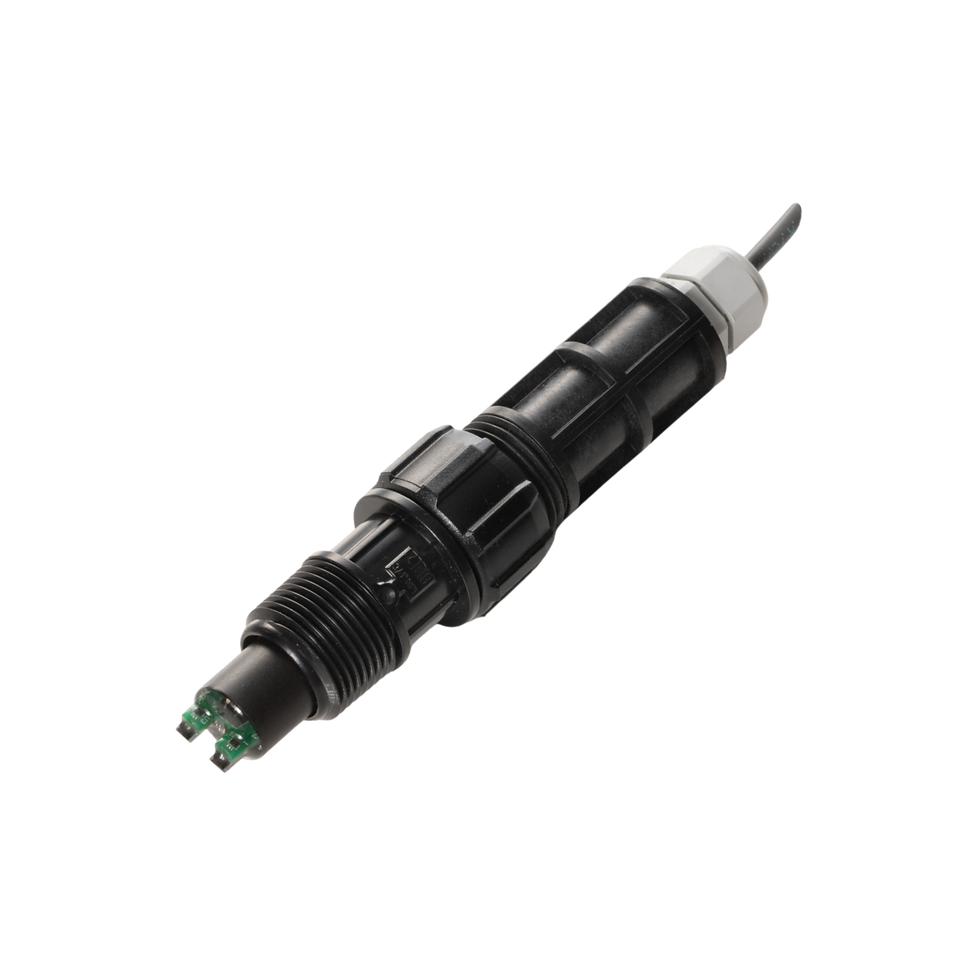
CTFS Sensor – Conductivity + Temperature + Flow Sensor
Conductivity Sensors
Digital conductivity sensor with integrated temperature and flow monitoring for cooling water systems. Designed for reliable, real-time measurement and improved process control without moving parts.
Measuring range: 100–10,000 µS/cm | Max. pressure: 102 psi | Temperature: up to 122°F (50°C)

2-Wire Boiler Sensor
Conductivity Sensors
Conductivity sensor designed for reliable monitoring in boiler and high-temperature applications. Built with a durable stainless steel body and fast response time for accurate performance in demanding environments.
Measuring range: 0.01–5,000 µS/cm | Max. pressure: 250 psi | Temperature: up to 410°F (210°C)

LFTK 1 DE
Conductivity Sensors
Cost-effective conductivity sensor for reliable measurement in clear, uncontaminated water. Features integrated temperature compensation for accurate readings and easy installation with standard fittings.
Measuring range: 0.01–20 mS/cm | Max. pressure: up to 232 psi | Temperature: up to 176°F (80°C)

ICT 2
Conductivity Sensors
High-performance inductive conductivity sensor for accurate measurement in chemically aggressive and contaminated water. Non-contact design prevents fouling and enables reliable operation across a wide conductivity range, even in harsh industrial environments.
Measuring range: 0.02–2,000 mS/cm | Max. pressure: 232 psi | Temperature: up to 257°F (125°C)